ES
ES  AR
AR  RU
RU  PT
PT 

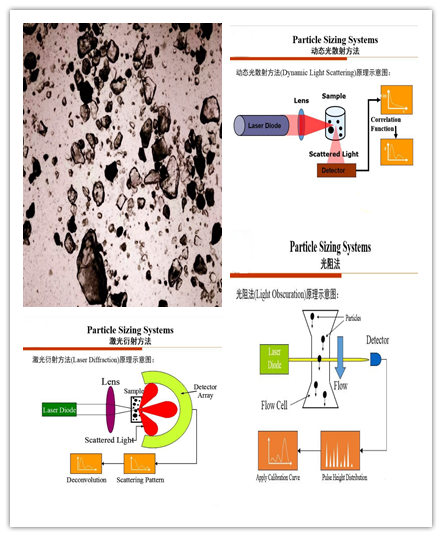
(1) Laser method: Advantages: simple operation, fast test speed, large test range, good repeatability and accuracy, and can realize online measurement and dry measurement. Disadvantages: low resolution.
(2)Dynamic image method: Advantages: simple operation, fast shooting and analysis speed, good repeatability and accuracy, can measure the largest particle, and can perform shape analysis such as circularity and aspect ratio. Disadvantages: cannot analyze fine particles (such as <2um), and the cost of the instrument is high.
(3) Static image method: Advantages: low cost, clear image, and shape analysis such as circularity and aspect ratio. Disadvantages: complex operation, slow analysis speed, unable to analyze fine particles (such as <2um).
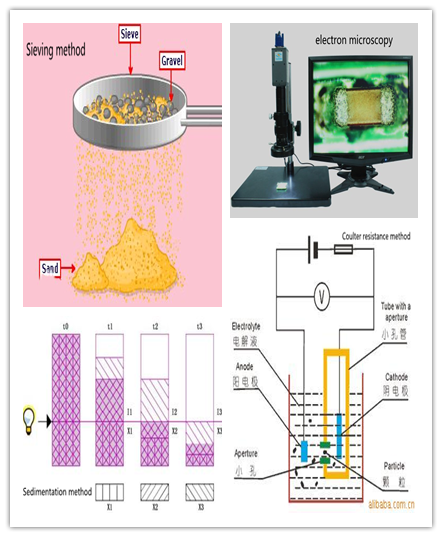
(4)Electron microscopy: advantages: it can accurately analyze the particle size and morphology of nanoparticles and ultrafine particles, the image is clear, the surface texture is visible, and the resolution is high. It is a standard method for characterizing the particle size of nanoparticles. Cons: Poor representation, expensive.
(5) Photoresistance method: Advantages: fast test speed, can measure the number of low-concentration particles in liquid and gas, high resolution, and less sample consumption. Disadvantages: This system is more complicated and not suitable for nanometer samples.
(6)Resistance method: Advantages: simple operation, measurable particle number, clear equivalent concept, fast speed and good accuracy. Disadvantages: Not suitable for measuring ultra-fine samples and broad distribution samples.
(7) Sedimentation method: Advantages: simple operation, continuous operation of the instrument, and low price. Disadvantages: The test time is longer and the operation is complicated.
(8) Screening method: Advantages: simple, intuitive, low equipment cost, often used for samples larger than 38um (400 mesh). Disadvantages: Cannot be used for ultra-fine samples; the results are greatly affected by human factors and mesh deformation.
(9) Dynamic light scattering method: Advantages: fast test speed, good repeatability, and simple operation. Disadvantages: There is a large error in testing broadly distributed nanomaterials.
(10) Ultrasonic method: Advantages: It can directly measure high-concentration slurry on site without diluting samples. Disadvantages: The resolution is low, and the results are greatly affected by environmental factors.
Copyright © Jinan Winner Particle Instrument Stock Co., Ltd. All Rights Reserved | sitemap